Texts: Genesis 1.1-2.1; Matthew 28: 19-20
In John Hershey's book The Call, young David Treadup responds to a the words of a preacher exhorting his audience to bring the Gospel to the “heathen Chinese.” Born in China himself, the son of American missionaries, Hershey writes about David's response to an alien world that looked at him with suspicion and envy at the same time, that feared that the Gospel he preached meant a loss of national independence, and exploded in anger against him as an example of Western imperialism. The preaching of the Gospel has always involved some form of imperialism, whether it is cultural, political, or economic. And it makes sense, if you think about it.
From the earliest days of missionary activity, beginning with Peter and Paul, baptizing people in the name of the Father, Son, and Holy Spirit, meant those baptized abandoned their old ways of living, whether those ways were ways of war, pillage, and plunder, or cultural identity. And when Christianity became the official religion of the Empire, baptism and conversion meant new political allegiances and subservience. Constantine's converson and drive for a greater Roman Empire were indistinct as was the conversion of Clovis the Merovingian in 496 and his drive for power in what came to be called France. And the move to make disciples in Scandinavia was coupled with a desire to stop the Viking raids on Iona and monasteries along the Irish coast. Although this conversion process took several hundred years, when it was completed by the early twelfth century, the Swedes turned their imperial based conversion activities to Finland slogging through the many lakes to create a Swedish empire.
The rapid growth of Christian missionizing in the late dark ages was rivaled only by the drive to Christianize the heathen of Asia, Africa, and, of course, the American plains. Native American children were taken from their heathen homes and put into Indian boarding schools where they were forbidden to speak their native languages, forced to dress like prim and proper white children, and often forcibly broken from their native cultures. By the 1850s and especially post Civil War, missions flourished in Indian country, buttressed by the U.S. Cavalry that saw the missions as little more than the extension of Federal power and influence, a way to open the Plains to white settlement.
When I was growing up and, I daresay, when some of you were growing up, missionary work was considered a holy venture, a way to bring the lost to Christ. An old friend of my late husband, when he heard we were getting married back in 1962, wrote a delightful letter about his work in the jungles of Brazil. His closing line was classic: “Now that they know Christ, they wear clothes.” In other words, they've become like us. Some Christians have not moved beyond thinking of the world as full of poor benighted souls who will face the fires of hell because they've never been baptized – or because they don't wear clothes.
However, a new kind of missionizing took root in the beginning of the last century – sounds strange, doesn't it, to refer to our own times as the last century. The young brilliant theologian and organist Albert Schweitzer studied to become a doctor to bring the heart and soul of God into Africa by practicing what Francis of Assisi once said: Preach the Gospel at all times; use words if necessary. At the age of thirty, he studied medicine and in 1913 left the comfort of Alsace-Lorraine and went to French Equitorial Africa to be a medical missionary. This was before the age of fax machines and cell phones, if you can imagine it. As a German citizen he was interned by the French during World War I and returned to Europe after the war bringing with him the awareness of a new and different world to the many audiences that flocked to hear him preach.
Like St. Francis, Schweitzer was acutely aware of the natural world around him and urged stewardship of the environment as the creation of God to be protected rather than to be exploited by companies and the government power they have bought with lobbyists in their drive for greater and greater profits. He made disciples through the model of his life rather than the facility of his words.
In today's world we are challenged by this ancient call to make disciples. It involves more than just preaching and baptism. To make disciples of others, we must be good disciples ourselves. That entails looking at the demands that the Gospel makes on our lives, something that we – including me – are not very comfortable in doing. There are days when I really wonder why I do what I do. I get tired like everybody else and have this tremendous desire just to stand outside and scream. It's probably one of the reasons that I at least try to work out – it relieves the tension of this demand hanging over my head. I joke about the books that seem to take over my house, but I realize that, too, is another way of relieving the tension of the demands I feel I face. We all have different ways of coping with those demands, some more healthy than others.
Each of us has a different kind of response to the call to make disciples. For some of us, it means giving up time to walk dogs that are in an animal shelter; for others, it means delivering mobile meals; for others, working at the Calico Cat. We make disciples of others in the way that I think Jesus intended by being disciples. In that wonderful story of judgment a few chapters earlier in Matthew's Gospel, people are separated not by what they say, but by what they do: feeding the hungry, clothing the naked – add your particular calling to the list.
Being disciples also means living in community with each other, sharing our hopes and fears, listening to others, and caring for the church as the visible sign of the body of Christ. At times, it also means taking unpopular stands on issues that affect the wider community, such as affordable housing, beach access for all, offshore drilling, environmental stewardship, poverty, and the racism we are now witnessing in xenophobia. I have to make a personal statement here. All week I have been stewing about the new law passed in Alabama that would make it a crime to feed or care for undocumented immigrants, even to take them to church. I feel I have a special responsibility to comment on this since my mother was born in Alabama and I spent a lot of time as a child there. I felt so grateful that my father had rescued her from that place. But enough of that though it's not quite out of my system.
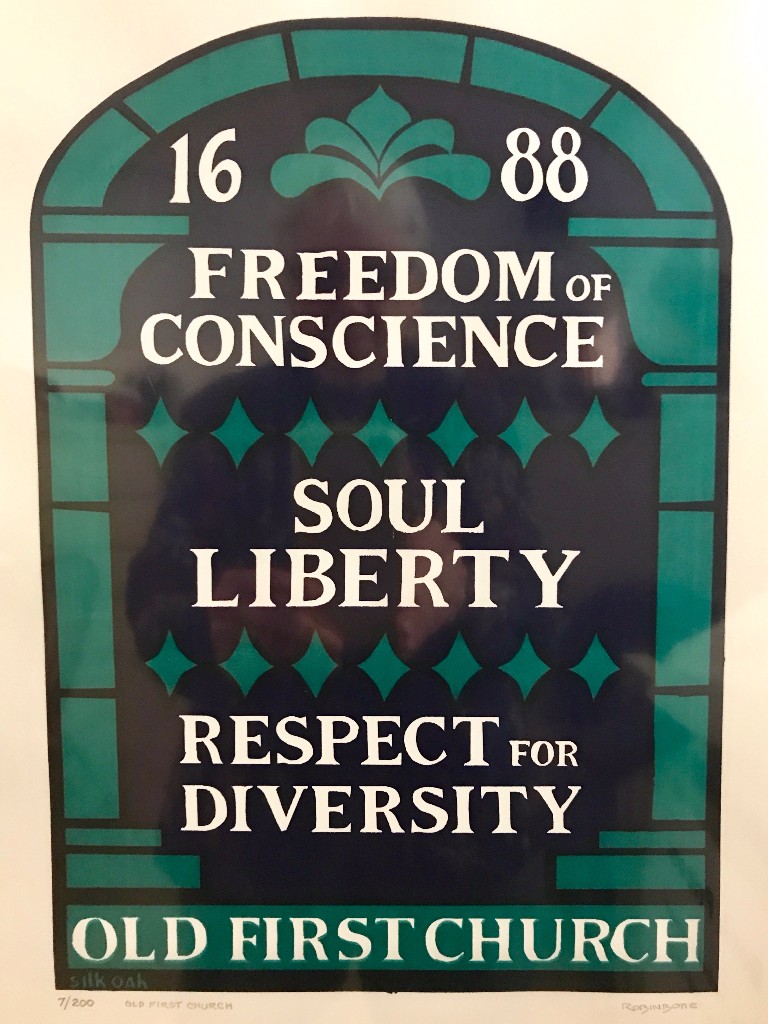
Being disciples is what we are called to do as we seek to make disciples. And making disciples means that we urge others to act in a truly Christian way towards others, one that includes all people regardless of their age, race, religion, gender, immigration status, or sexual orientation. And it means that we urge others to act in this same inclusive manner. Making disciples means studying the issues that affect our lives and speaking to them. It does not mean that we all agree on all the issues but that we open ourselves to others in the framework of our faith. We are called to respect diversity not just of people but of opinion as well – soul liberty – freedom of conscience. That's what our ancestors came to the swamp of New Jersey to achieve. In doing so, they built a society that respects diversity and the freedom to speak our minds. Making disciples means that as well.
There are many ways to baptize others as we make disciples. We can also baptize with the spirit as well as with water – with actions as well as words. The baptism last week is but one visible sign of the invisible community. By living in community with each other, we baptize in the Spirit, that Spirit of God that holds us in the very heart of the holy and the divine. We are then disciples and will make disciples.
Let us pray: Holy One, who created the heavens and the earth within the vast incredible universe, help us to be disciples of your word through our lives. Help us to make disciples by the way we live. Help us to always preach the Gospel, using words when necessary. Amen.